Monday, December 10, 2018

My Tool All-Stars

I began my career as an electrician in the year 1965 when Dad first paid me at the rate of $1.50 per hour to help him wire a cold storage warehouse. Soon after I started, Dad put together a tool pouch for me with a few carefully selected hand tools. It is amazing how little you can accomplish without a metal tool in your hand. Fingers are nearly useless for turning a simple screw. After working a few hundred hours with my tool pouch belted to my left hip (I am left-handed), these few tools became an extension of my body. My hand fell to the desired tool without looking and with little groping as each tool has its own unique feel. After more than 50 years of companionship, my tool pouch has changed very little from the one Dad first gave me. I've always used a leather pouch made by the Klein tool company, having eschewed the padded-nylon fabric pouches that are currently popular. Leather does a much better job of molding itself around the tool in response to its constant touch. They do a better job of holding the tools in place while bending over and crawling around in tight places. They are also a long-lived creature; I believe I am using only my 3rd pouch in all these decades. It's a good thing I am near the end of my career as I can no longer find my favorite pouch on the Klein website.


 Tool selection for a comfortable hip pouch is an critical compromise. Too many tools are a burden that impinges on the required athleticism of the all-round wireman. Too few and you'll be running back to the truck too often.  Dad's pouch included the following tools:

• Large straight-blade screwdriver. This is likely to be pressed into service as a pry bar or chisel.

• Small straight-blade screwdriver. Also good for punching small holes and probing behind drywall.

• Long-nose pliers. You simply can't be an electrician without these bionic fingertips - most often used to wrap the end of a wire around the head of a screw.

• Folding electrician's knife. Used for stripping insulation off wire and many other things.

• Diagonal cutters. Fondly referred to as "dikes." A good pair of high-leverage Kleins are worth their weight in gold and will cut nails almost as easily as copper wire.

• Lineman's Pliers. These have a broad, flat nose with generous knurled gripping surface and side cutters. Also, not bad as a little hammer to beat on the end of a screwdriver.

• Electrical tape. Uses are obvious - binding things together and insulating live parts.

To this basic assortment I soon added the Phillips screwdriver as we increasingly encountered this type of screw. Next was the 1/4" nut driver as we began using a hex-head screw to mount things on wood. After about 15 years of doing things Dad's way I began to make adaptations of my own. I changed to a different model of Klein leather pouch that included a hammer loop. I threw out the lineman's pliers because they are heavy and I found that 95% of the time I had been using them as a hammer against the end of my screwdriver. The only wire strippers Dad had were a bulky and complex contraption that gripped and stripped in one motion. Clever, but they didn't fit into a compact pouch so I either used a knife (slow) or made a trip to the truck to fetch the stripping gadget (inefficient).  Some cheap and simple wire strippers to the rescue. I doubt Dad would have approved of this as he exhibited a great fondness for excessively complex solutions to mechanical problems. I tired of running back to the truck to fetch my bulky multi-meter merely to determine if a wire was hot so I added a little volt-stick type non-contact tester. I'd love to carry some Channellock adjustable pliers but they are a bit too large for my favored pouch so I find myself gripping and twisting things with long-nose. Plus, they rattle when I walk and it was the rattle of the electrical tape chain that finally irked me enough to induce me to whack it from my pouch. It's good to sever oneself from these little annoyances.

 Tools in my current pouch.


Now I come to the selection of the tools that have made the most dramatic improvement in my professional life. These, I call my
 Tool All-Stars.

Whenever I encounter an electrical box fastened down with the old flat-head, straight-blade wood screws I nearly shriek in horror at the suffering they undoubtedly wrought upon the old-time electricians. Just removing one is bad enough. It must have been sometime in the late 70's that electrical wholesalers started offering the Robertson Head sheet metal screws and drivers. Also known as Locked Recessed or square drive, these screws have long been the standard screw in Canada and have made a huge difference in the lives of electricians. They are not perfect but will take a lot of torque without stripping out and stick on the end of the screwdriver better that any economical and practical screw I've tried.

Robertson Head screw and driver


My first cordless drill didn't see much use. An electrician wants a drill with good power and battery life. The early drills were not up to the task. My second drill was a Makita that proved very handy. While it had nowhere near the power of a corded drill it served well enough to revolutionize the jobsite. Later DeWalt drills were much improved but the old Makita was an All-Star tool in its time.

Makita 9.6-volt cordless drill


Speaking of Dewalts, my collection of 18-volt yellow tools has proved to be much more robust than I would have imagined. The oldest drill is still going strong after 2 decades of heavy use and abuse. The Ni-cad batteries tend to last about 3 years before they become too week for hard industrial use. I try to have at least 3 good batteries in the truck ready to go. We've used them for driving screws more than drilling holes since much of our drilling involves 1/2" and larger holes through 2 or 3 layers of 2-by material but they have been a huge time saver. We also use them for cutting conduit holes on metal cabinets with carbide bits.


As a sub-category to the cordless drill I should give honorable mention to the keyless chuck. This invention has saved me almost as much time as the cord-free drill itself. Once exposed to this time-saver I began to loath the chucks on my corded drills. I managed to find a 1/2" DeWalt pistol-style corded drill with a keyless chuck and a button on the side to lock the rotor while applying a goodly amount of torque to the chuck collar. My only real complaint with this drill is that it has almost too much power for one-handed use. This has forced me depend on the big right-angle Timberwolf for heavy drilling.


Dad always bought GMC pickup trucks and had a service body installed. These had 6 or more compartments on the outside making for easy access to tools and parts. The wide horizontal door swung down to form a very useful work bench. When I talked to electricians working out of a standard cargo van I always got negative reviews. They had to crawl over a pile of parts to get to anything. The problem we had with our service bodies was the low, Dad-built canopies which required us to crawl over a pile of parts to get to the items too large to fit into the side compartments. I tried going without the canopy but an open truck parked outside in a snowfall made for a real mess.  When driving down the highway boxes holding lightweight parts had a habit blowing out in the wind.

As a solution I thought I might purchase a 10' box van and build doors and compartments into the side walls. This would give me a 6' ceiling inside plus all the utility of the service body. I was only beginning an internet search when I came across a box van that already had the side compartments. I knew the moment I saw the photo I had to have one. I was only able to locate this one used van for sale on a truck lot in Palo Alto. I flew down the next day and drove it home. This truck made electrical work almost fun. I can't imagine the agony of going back to the old trucks. It holds my conduit, 10' extension ladder and has 40 feet of shelving above a 4' X 10' floor.


Next on the list is a great cordless circular saw with an All-Star blade. I saw a new Milwaukee cordless, metal-cutting  circular saw being demonstrated and knew I needed one. This saw was basically their standard cordless wood saw with an extended shroud over the blade to cut down on the flying metal shavings. It was fairly expensive so I reasoned that I might put up with  the flying shrapnel and put the Milwaukee blade in a standard DeWalt saw I already had the batteries for. This has worked so well I haven't used a hacksaw once in over 10 years. It will cut 2" rigid conduit, uni-strut, re-bar and just about anything else, metal or plastic. It doesn't have enough "set" in the teeth for wood but is usable for short cuts.
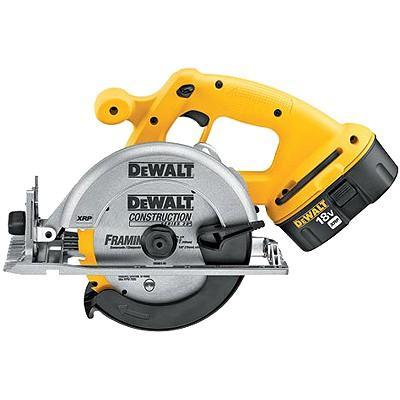
 
 The key is getting the expensive metal-cutting blade.


Here is a tool I didn't think I really needed but now I use it all the time. A home handyman told me his impact driver "changed his life" so I thought it deserved a second look. It works like an compressed-air impact wrench on a smaller scale, using our existing DeWalt batteries. The really handy feature of this tool is the 1/4" snap-in chuck that accepts our numerous screwdriver and nut driver bits. It now drives most of our screws and uses less battery power doing it. I also found that snapping in a 1/2" socket drive adapter and 1" socket, it has enough beans to use with a 2" Knock-Out punch. This saves a lot of arm work wrenching on a big ratchet handle.
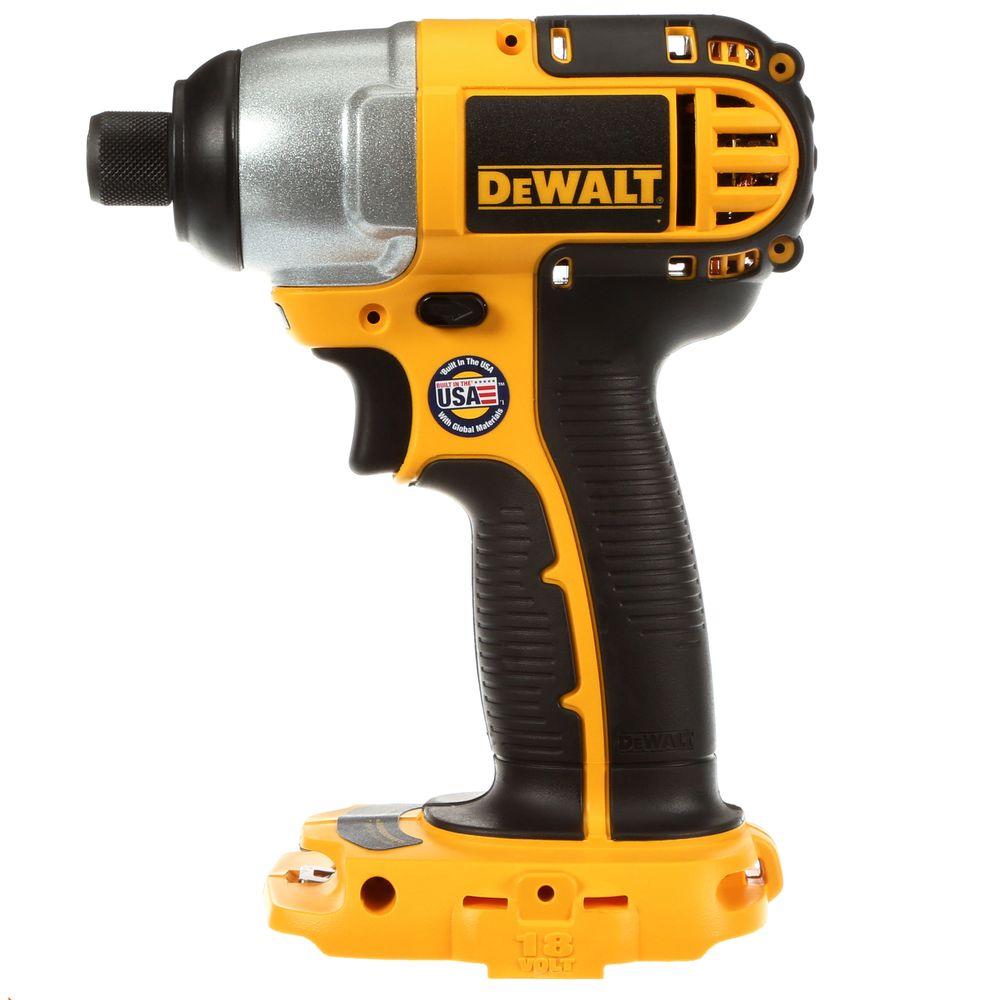


Battery technology has made great strides since I bought my first 18-volt DeWalt tool. Manufacturers have upped the ante with higher voltages, amp-hour ratings and lithium technology. I saw no reason to ditch my trusty DeWalts when they were serving so well and I had a lot invested in tools, batteries and chargers.

Then it happened. A plumber showed up at the job site with a drill that rocked my cordless world. Plumbers drill a lot of very large holes. It was plumbers that lifted the original 1970 Milwaukee Hole-Hawg to its reign as king of 1/2" drill motors. I never owned one but instead opted for the newer Black & Decker Timberwolf as it had a bit more power and worked in tighter spaces.

 Enter the drill of my dreams -- the Milwaukee M18 FUEL cordless Hole Hawg. When the plumber told me he never gets out his old corded drill when drilling out a new house I was totally captivated. I watched him buzz through a double 2X6 with a 4-1/4" hole saw in mere seconds and I came down with a severe case of power tool envy. It was only when I learned the price that I had to take a deep breath and ponder the necessity of owning such a piece.

This new drill is amazing and worth the price. We drilled out an entire 3-bedroom house on 2 battery charges! It runs through 6 stacked studs with a 3/4" auger bit faster than the mighty Timberwolf! How is this possible? I don't really know but I think it has something to do with the new brushless DC motor technology. I went for the big 9 amp-hour battery and this drill just rocks. If that wasn't enough, it comes with a snap-in chuck that accepts all my newer auger bits and a hole saw arbor. No more fumbling for the chuck key. No more time spent twisting and wrenching to insure the bit is held tight in the chuck. This drill is so impressive I bought a second one. How many times have I climbed a ladder only to find the extension cord is caught on something forcing me to climb back down and back up again? They should eventually pay for themselves in increased productivity. Until then they make the work a lot less aggravating and that is worth a lot.
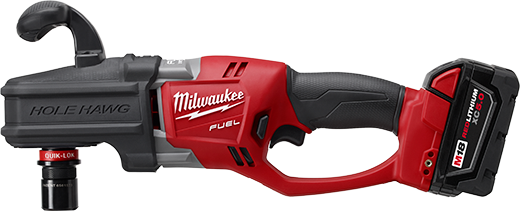

Wonder Drill of the AGE


Tuesday, January 15, 2013

Pirsig's Wisdom

From   Zen and the Art of Motorcycle Maintenance by Robert Pirsig


“Peace of mind isn’t at all superficial, really,” I expound. “It’s the whole thing. That which produces it is good maintenance; that which disturbs it is poor maintenance. What we call workability of the machine is just an objectification of this peace of mind. The ultimate test’s always your own serenity. If you don’t have this when you start and maintain it while you’re working you’re likely to build your personal problems right into the machine itself.”

“The test of the machine is the satisfaction it gives you. There isn’t any other test. If the machine produces tranquility it’s right. If it disturbs you, it’s wrong until either the machine or your mind is changed. The test of the machine’s always your own mind. There isn’t any other test.”

“The craftsman isn’t ever following a single line of instruction. He’s making decisions as he goes along. For that reason he’ll be absorbed and attentive to what he’s doing even though he doesn’t deliberately contrive this. His motions and the machine are in a kind of harmony. He isn’t following any set of written instructions because the nature of the material at hand determines his thoughts and motions, which simultaneously change the nature of the material at hand. The material and his thoughts are changing together in a progression of changes until his mind’s at rest at the same time the material’s right.”

“Sounds like art,” the instructor says.

“Well, it is art,” I say. “This divorce of art from technology is completely unnatural. It’s just that it’s gone on so long you have to be an archeologist to find out where the two separated.”


Sunday, July 12, 2009

Necessary Evil

I think of government as a necessary evil. It is both necessary and evil. Without it there is usually anarchy, chaos and rampant evil as the strong rule over the week. With a carefully measured amount of it there is a chance for justice, peace and prosperity. Government is evil because it’s only action is one of force. When the amount of government grows beyond what is necessary to achieve this balance of justice, the element of necessity recedes leaving the other element to dominate – that being evil. With excessively powerful government, whether by dictatorship or democratic majority, the strong are again found to rule over the weak. Only at the balance point of necessity do we avoid the concentration of evil at either end.

Wednesday, April 22, 2009

What is Torture?

The definition of torture is in the news these days. The United Nations has a fairly loose definition that includes this key phrase: “…any act by which severe pain or suffering, whether physical or mental, is intentionally inflicted…” Mental pain could easily include a wide universe of emotional and psychological effects. Personally, I imagine that being sent to a maximum-security prison, where I would be very much in fear of being beaten, raped or killed by fellow inmates, would be a kind of “severe” mental pain. Can we safely say that inflicting such fear in a person is humane while other forms of mental pain, such as sleep deprivation, are not? Is mental pain acceptable if it is less extreme but spread over a longer period of time? In my profession I have had occasion to receive many accidental electrical shocks. The pain is quite severe but very short in duration. I much prefer this kind of momentary pain to the extended emotional pain experienced during family strife or in anticipation of a government audit.

When I was young and first exposed to stories of medieval torture techniques, I saw the deliberate mutilation of the victim’s body as being the unconscionable core element of torture. The infamous Thumbscrews, Rack and Iron Maiden seemed horrific beyond my curiosity to even imagine the suffering. But it is not the initial pain alone that makes me shudder; it is the lasting agony of damaged flesh and bones should one be allowed to live on. This is definitely torture.

Watching the controversy unfold over interrogation techniques used on terrorists in an attempt to save more lives from being lost in the future attacks likely to come, I have attempted to arrive at my own definition of torture. For now I am satisfied with the notion that inflicting lasting physical damage to a person’s body for the purposes of coercion or punishment is torture. Making a person fear for their life does not seem to qualify. If it did we would not be able to incarcerate criminals into the general prison population. Inflicting mental anguish, in most cases that I can imagine, would not qualify for the same reason. If the treatment went on to the extent of causing a person to be permanently mentally debilitated, then I would say the line has been crossed. I have recently learned that we have waterboarded thousands of our own agents and soldiers as part of their training! It sounds extremely unpleasant but in such extreme situations as we have found ourselves in following the 9/11 attacks, I wouldn’t call it unconscionable or torture. Now, if it’s driving sticks under the fingernails, then yes.

When news broke of prisoners being taken to our base on Cuba, my immediate thought was that this was a big mistake. These kinds of ideological warriors cannot be rehabilitated and released to their homes. I thought it would have been much better if they had died in a firefight -- that we should have made sure that they did. Now I am aware of the vitally important information we were able to obtain from some of these prisoners. Getting this information has likely saved many lives but I can’t help but believe there was a better way to handle the whole situation as the resulting quagmire is far from being resolved.

Sunday, January 18, 2009

Inauguration Day

They say we are swearing in our first "black" president today. Obama is black because his father is African? What if Africans had settled America and for a time enslaved captured Europeans? Would we be calling Obama our first white president? Africans have brown skin and Europeans have an odd light tan color. Calling us black and white seems like a bizarre exaggeration designed to perpetuate racism. When I look at Obama on TV he appears to have a slightly darker shade of tan than many of the people around him. So what? When will this preoccupation with skin color and ethnic origin end so we can talk about things that really matter? We often hear that Obama is the most leftward leaning member of the Senate and I never hear anybody disagree with that. Where he will lead this nation is vitally important. His skin is not.

Friday, December 5, 2008

The Sinister Signpost

Our governor Gregoire was on national TV tonight. She has allowed a sign listing a vitriolic atheist manifesto against religion to be placed next to a nativity display in our state capital. This in the name of what? Equal time/space? I think we can see where this kind of silliness will lead. In a nation made up largely of Christians we have a long tradition under attack. Should the Nativities have been allowed in the first place? I'm not going to define separation of church and state here. I have to wonder though, why the teachings of Jesus do not have a legitimate place in our national consciousness alongside those of Abraham Lincoln and Martin Luther King. We have a paid holiday in Jesus' honor. We don't need to accept the miracles to recognize the immensity of his contribution to our heritage of brotherly love and mutual respect. One could argue that much of what makes America great is due in no small part to Jesus. Why should the government not sponsor a display depicting this important birth? Are the atheists really so offended by his teachings? Should the Neo Nazis be offered space in our capital to explain what offends them? I might like to put up a board myself.

Correction

California's vote on Proposition 8 was essentially a test to see if homosexual "marriage" is politically correct. The answer is no, it is not politically correct. Not in California. Not at this time. The body politic has spoken. A bit of a twist.

Sunday, September 14, 2008

A Tale of Two Faces

I’ve come to believe that as we age, the muscles and fleshy structure of our faces take on a shape that portrays the most prevalent thoughts and feelings that occupy our minds. The word for this is derived from Old French: contenir – to contain. Countenance is the picture we see on a person’s face and the premise is that a face can be read like the pages of a book. Some faces are difficult to read and others quite easy. My own ability to read a face is not formally trained or scientific. I rely on my instincts, subliminal processes and experience with people. My hope is for a telling discernment.

The two most prominent women in American politics today are Hillary Clinton and Sarah Palin. When Palin walked onto the stage with McCain for the first time I knew nothing whatsoever about her. This condition within my own brain lasted only milliseconds. I was immediately struck by the difference I saw in her face as compared to what I usually see in the face of a seasoned politician. In place of the hardened and fortified expression of those who have spent years battling to advance their political agenda, I saw a freshness and an almost child-like innocence. If the eyes are the window to the soul, who could help but notice that Sarah’s eyes are wide open, accessible and transparent. They exude a cheerful optimism and peacefulness not often seen in the dour circus of political figures.

In contrast, there are few persons that have affected me the way Ms. Clinton has. Rightly or wrongly, I have powerful impressions when I read her face. Her countenance gushes forth with volumes of descriptive information. There is a hardened seriousness to achieve her goals, possibly at any cost. Cold and calculating to near the point of absolute zero, I wonder if any cost is too high. Any expressions of pleasantness seem slightly unnatural, if not forced. I see a clever person, but without the skill to completely veil the inner self. I feel a chill in the air.

Time will tell if Palin can survive the onslaught of political scrutiny or the pressures to conform to the will of other, more powerful, figures and yet retain any semblance of innocence. The coming decade will reveal if Hillary’s massive ambition will go unrequited and leave even more lines and bulges of bitterness on her face.

In fairness, I must acknowledge that Sarah was blessed at birth with the genetics of a pretty face. Still, I have seen that beauty can be either cultivated or scared-over by the thoughts we entertain. The eyes and the mouth are particularly susceptible to the impulses unconsciously transmitted from the brain. I sincerely hope that Sarah’s eyes remain transparent and charitable. As Charles Gibson interviewed her recently, I thought I saw in her eyes a temporary emotional fortification, as defense against the massing forces of political animosity. I hope it’s temporary, and I hope I’m right about what lies behind those eyes. For Hillary’s sake, I hope I’m wrong about hers.

Tuesday, March 18, 2008

The Right to Govern by Force

There is a question that should be posed and answered whenever we contemplate an action to be undertaken by our representative government. That question must recognize what government is, and then ask what government properly has the right to do. As for the first, George Washington gave us a searing declaration, to wit: “Government is not reason, it is not eloquence; it is force, and like fire, it is a dangerous servant and a fearful master.” So government is force, and in practice it must, of necessity, bring to bear any force that is required for the job at hand.

The question is no easy one to answer. Our founding Fathers understood that a just government derives its authority from the governed. We, the people, delegate to our own government the powers necessary to govern. With this insight we realize we must ask ourselves, what rights do I have, individually, to exercise power over my fellow citizens? What intrinsic rights do I have that I might delegate them to my government? To sort out the thorny possibilities inherent in this question, we must imagine a state without government for, once created, we are required to act within our law. What force may I properly and morally bring to bear against my neighbor in protection of my own rights and property? If the only disagreements we had with our neighbors were over private property rights, this would be a much easier question to answer. When we must also deal with public properties and institutions we are bound for trouble. A few examples will bring this to light.

I have a moral right to protect my own property, even to the extent of shooting a burglar in my house. I can, therefore, delegate the right to shoot a burglar to my local constabulary. If my village votes to build a public road, we might want to create laws governing behavior on that road. We might feel we have a right to enforce civil behavior for our own protection while traveling the road. Thus we extend rights of private property to the public sphere and agree to live within common rule. The right to stop threatening behavior on our own property is transferred to the public road. We then may choose to hire law enforcement officers and delegate authority to them to insure more consistent compliance with written law, to which we are party. Few will find fault with this approach but we see that things have gotten much more complicated. I may have the right to control my neighbor’s speed on my own property and on my public road. Do I have the right to force him to limit his own personal risk while on that road? Can I delegate to my government the power to force him to use a seat belt solely for his own protection? If so, where did I get that right?

A much more poignant question involves the forceful redistribution of private wealth. Can I require one of my neighbors to help another neighbor? Do I have the moral right? If not, how can I delegate that right to my government? What happens if a law is passed requiring some of the villagers to help other villagers who are seen as having greater need? If the law is not enforced it is useless and the effect is deleterious to all law. The law must be backed with potential threat of all necessary force, including lethal force, in order to uphold the fabric of lawful order. Let me restate the question. Do I have the intrinsic moral right to force my neighbor to give part of his substance to another neighbor? Do I have the right to take from him against his will if he votes with the minority? Am I willing to threaten him with imprisonment or death if he resists? Can we shrink from these questions when this very dynamic plays itself out all around us every day?

As a mental exercise, I like to imagine an unusual scenario in which I am not able to hire away some of my public duties. In my village, the responsibility to collect taxes is rotated around to all members of the village as a civic responsibility, much like jury duty. When my time comes to serve, I am required to visit my neighbors and collect all taxes due on the public services I have supported. In order to ensure compliance, I wear an official badge and strap on a pistol. The chance of real resistance from my neighbors is remote because they know I am authorized to use all necessary force in the collection of taxes. I usually have to listen to the complaints of those who did not support the government programs and policies for which I collect. Some of these people are vehemently opposed and resent having to pay for something they do not want. As I listen to their arguments, I am face-to-face with the rather ugly reality my vote has perpetuated. Now, as I consider imposing my will upon my neighbors with my next vote, I ask myself: What is proper? What is necessary? What are my rights to control others? What wonderful government program am I willing to impose upon my neighbors against their will? How much am I willing to take from them, merely because I am willing to contribute myself?

Monday, March 17, 2008

The word LIKE like spreads like a virus

I remember a time when only Maynard G. Krebbs used the word LIKE in so useless a fashion. The trend no doubt started in California (as so many distasteful trends do) but has now completely invaded our society. People near and dear to me have been infected by the virus. Young people are especially vulnerable. The victims soon forget how to use the words ALMOST, ABOUT, APPROXIMATELY and the like. Then they succumb to using the word LIKE as a hedge against the possibility of error or as a built-in apology for inexactitude. Finally they simply throw the word into every sentence as a filler.

Sometimes the word is artfully (?) woven into an ordinary sentence several times. For example: "He, like, came in the room and, like, picked up the TV set and, like, started to, like, walk out with it. And I go, 'Like, what are you doing man.' And he goes, Hey dude, this is, like, my TV, man.' And I, like, go, 'Like, no way, man. I, like, paid to get it fixed and it cost me, like, fifty bucks, man."

You get the picture. Actually, I'm sure you got the dismal picture long ago as the above example is no exaggeration. In fact, you might have contracted the disease yourself and are totally unaware. When I find myself under a LIKE attack, I wish for a little hand-held digital counter that I could keep hidden in my pocket, silently clicking the counter for every LIKE. At the end of the barrage, I would whip out the counter and announce the number of LIKES to the astonishment of all. My worst fear, however, is that I myself may unwittingly become a perpetrator. My wife, like, has, like, strict instructions to, like, shoot me dead if that should, like, happen.

Monday, February 11, 2008

What? Me Believe?

When we believe what politicians say while on the campaign trail, we deserve the bad government we will get. A politician's job is to be all things to all people. A good politician will tell as many lies as he can get away with. He is a master of saying nothing and making it sound like he is saying something. He knows how to promise things he can't possibly deliver and get people to believe it. I wish we were merely electing a charismatic national speech giver, while a homely little man (or woman) who understands the proper role of government was hiding behind a curtain and pulling the levers of good government.

Saturday, January 26, 2008

Name Tag Disease

I saw a news item on TV today about shoppers lined up outside a store to purchase the latest Air Jordan shoe from Nike. These babies were selling for well over $200 and the sorry saps were ready to buy them sight-unseen. I couldn't help but think that what they all needed was a good dope slap. I hate wearing clothes with a conspicuous brand label. I don't mind paying for quality on (rare) occasion. I just don't feel like I should provide the company with free advertising. They should give me a discount for that. What if somebody thought I was flaunting the brand name status in order to make a big impression? Horrors! They'd say to themselves; "There goes poor Ted. His self esteem is so low he's trying to pump it up by paying extra for name brand products." I'd be tempted to cut the label off. Now why should I do that? Why should I care what they think? Maybe this is just another kind of vanity. Ah shoot. I'm working on perfection but I've got a long way to go. If I ever get there my wife will know right away because my body will quit producing intestinal gas. Now, where is that coupon for the $8 jeans at Bi-Mart?

Bee's Wax has Wained

When was the last time you asked somebody something and they responded by saying ... "None of your bee's wax." What a social tragedy if we let this little gem die out. We must do our part to see that it gets passed on to the younger generations. Try using it at work. The boss will be so pleased to hear it again he might not even fire you.